Clarification is one of the oldest and most extensively used technologies in water treatment. Sewage treatment clarifiers are components in waste water treatment process where it needs to remove suspended solids,turbidity and floating material from wastewater.
Mechanical clarification in the activated sludge process has double duty. It first yields clarified effluent and being a concentrator for setting up a concentrated return sludge to sustain process stability with system efficacy.
Working Principle of STP Clarifiers
Clarifiers work on gravity sedimentation systems. Wastewater flow is introduced at a controlled rate and sludge settles to the bottom due to reduced velocity of the flow. Sufficient tank size and depth allow solids to settle and form a dense sludge blanket, without being swept away with the clarified liquid effluent.
The settled sludge is removed by mechanical scraper devices. It further conveyed to a sludge hopper as clarified waters discharged out through overflow peripheral or radial launders.
Types of Clarifiers Used in STP & ETP
Centrally Driven STP Clarifiers
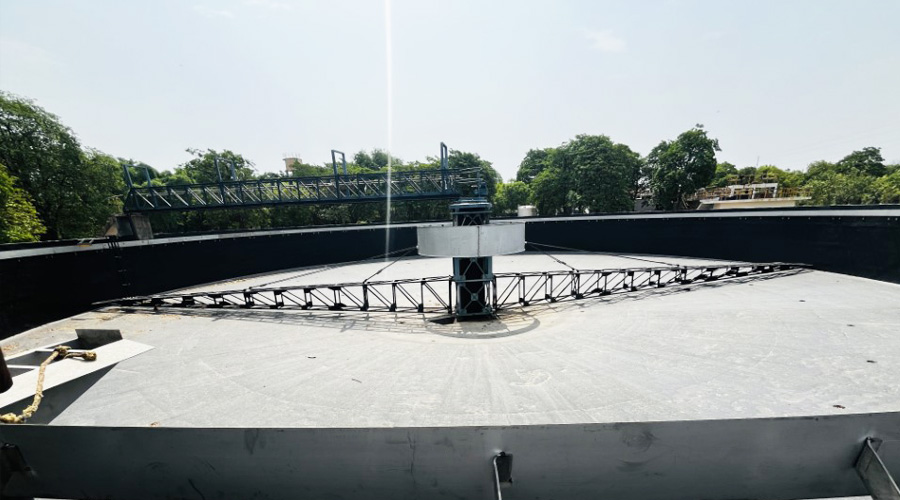
Central driven STP clarifier are common to wastewater and effluent treatment plants for sludge thickening and clarification. These installations have a pier mounted half-bridge or full bridge configuration, with the drives in center position.
They are perfect for medium to long walled tanks, capable of delivering a lot of torque strength and are dependable for extended duty cycles. It comes with optional features of scum skimmers, double launders and radial weir systems for optimum efficiency and flexibility of operation.
Peripheral Driven STP Clarifiers
Peripheral driven clarifiers are applied when the tank diameter exceeds 35′. In such systems the drive system is at the periphery of the tank providing an efficient transmission of torque to hollow scrape arms. They have heavy overload protection and are suitable for applications demanding large settling areas with minimal maintenance access.
Clariflocculators: Combined Flocculation and Clarification
Combined settling and clarification is achieved with Clariflocculators which help in better space utilization and cost savings. In the flocculation zone, chemical dose is applied to promote particle agglomeration and in the clarification zone flocs are allowed to settle.
These are widely used with sewage treatment clarifiers for raw water treatment plants, municipal sewage and waste water treatment, industrial effluent treatment and filtration pre-treatment.
Thickeners for Sludge Management
Thickeners are intended to increase the concentration of sludge by allowing it to settle reducing the amount of sludge for further processing and/or disposal.
Micro Transmission Systems thickeners are designed to optimize flocculation efficiency, self-dilution rate, as well as settling rates and high underflow density in comparison with its compact size. They are crucial elements in the operation of STPs and ETPs for effective sludge handling.
Conclusion
STP Clarifiers are the powerhouse of efficient solids/liquid separation in STP’s and ETP’s. For clarification, flocculation or sludge thickening, a reliable and cost effective solution that produces high dry solids and a consistent overflow quality is required with low operator attendance.
Decades of experience and a commitment to engineering with consistency are the trade-marks of Micro Transmission Systems. We’ve manufactured clarification systems designed and built to deliver reliable performance under rigorous treatment requirements.