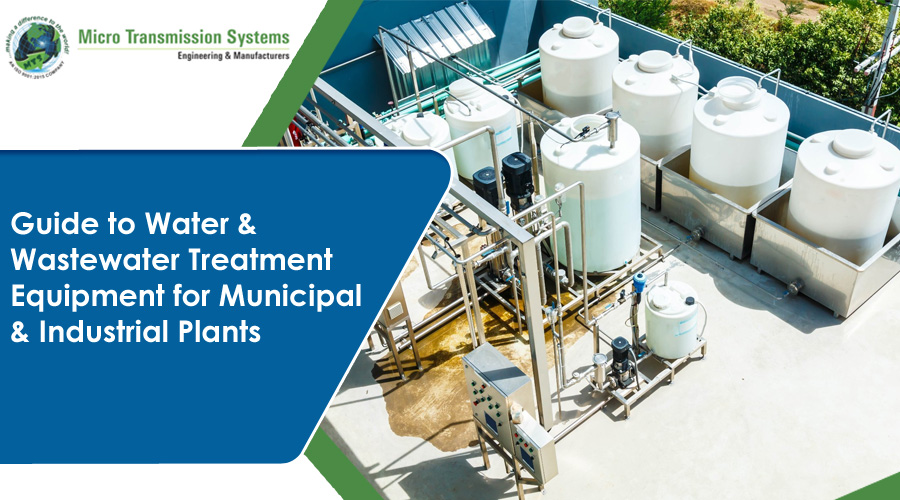
Waste water treatment is important for public health, environment and also for industrial productivity. Municipalities and the industrial process use a variety of wastewater treatment equipment to accomplish water quality assurance, regulation compliance and system performance improvement.
Being a leader in equipment manufacturers for water treatment, Micro Transmission System has come up with this blog where we’ll talk about a modern water and wastewater treatment practice.
Understanding Water Sources and Quality
Water treatment starts with learning how to find natural water sources, and the impurities that you will want to remove from it. Suspended solids, dissolved salts, organic matter and organisms are found in raw water.
Environmental concerns such as discharge standards, water scarcity, and sustainability also affect the design of treatment. Using quality techniques you should have uniform water standards in all our treatment stages.
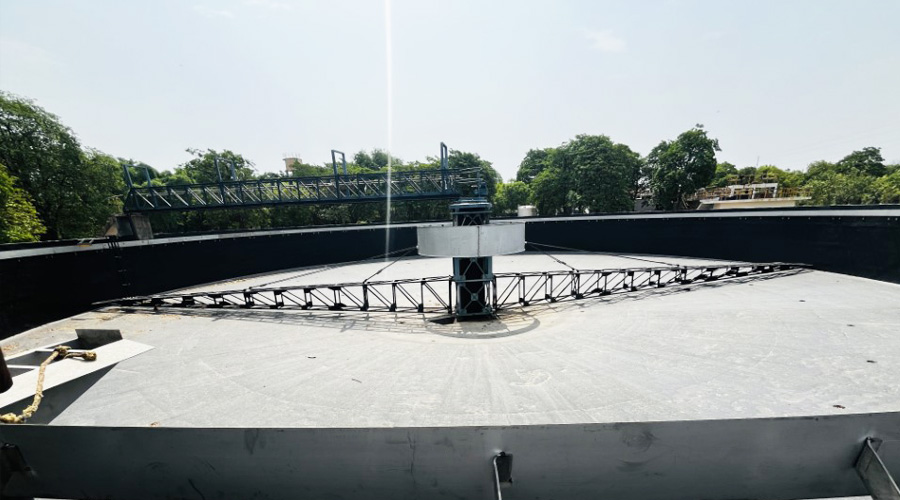
Wastewater treatment systems filter out pollutants before any water is returned to discharge or, for that matter, re-use. Clarifiers, biological treatment units and sludge handling equipment make environmental norms a distinct reality. Gas cleaning installations are also employed to control the pollution of industrial procedures.
Reliable wastewater treatment equipment, and testing devices are an essential to all stages of treatment. Water quality data is interpreted through analytical tests to make system adjustments and control the plant, if need be.
Core Water Treatment Processes
There are various treatment processes. Such as aeration which eliminates dissolved gases and enhances oxidation. Clarification method eradicates suspended particulates via sedimentation. Filtration systems, like sand, multi-media or pressure filters, offer better removal of impurities.
And advanced treatment processes like precipitation softening can lower hardness. Ion exchange systems take away specific ions, such as calcium, magnesium, or nitrates. Membrane systems such as reverse osmosis and ultra filtration systems provide effective purification for both drinking water for municipalities and also for industrial processes.
There is another system which is called boiler and cooling water systems. The water in boiler systems requires precise control to stave off corrosiveness, scaling and system breakdown. Deaerators, chemical feed systems, and blowdown controls guarantee boiler efficiency and steam purity. It is important to keep an eye on boiler deposits and corrosion as part of an overall inspection program because they can lead to extended life and downtime.
Conclusion
Sustainability of any waster water treatment plans dependent on effective use of equipment. Through the integration of the correct treatment technologies and effective monitoring and control, plants can achieve regulatory compliance, operational efficiency, and environmental responsibility over the long term.
Above all, it is quite necessary to use only trusted wastewater treatment equipment for the plants. At Micro Transmission System, we have been offering quality equipment since 1996 to waste water treatment plants.